
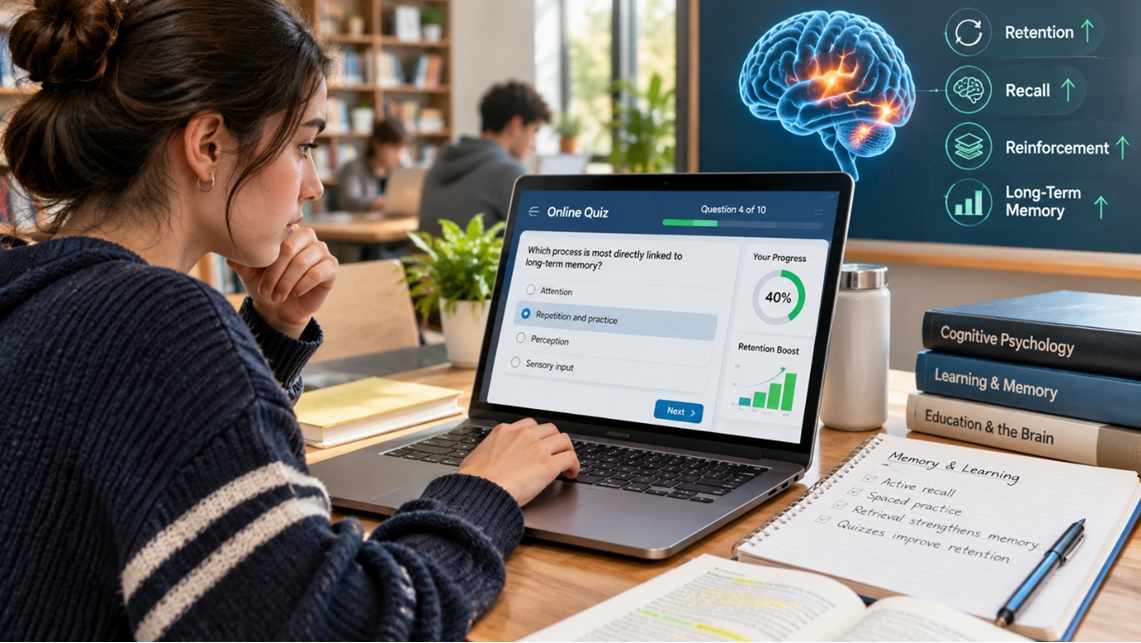
Think back to the last exam you crammed for. You probably reread your notes, highlighted half the textbook, and walked into the room feeling ready. A week later, most of it had quietly disappeared. That experience is so common that psychologists have studied it for more than a century, and one of their most dependable findings is surprisingly simple: answering questions about material does more for long-term memory than reviewing it again.
This idea, known as the testing effect or retrieval practice, sounds backwards at first. Most of us think of a quiz as a way to measure learning, not to create it. Yet hundreds of experiments show that the act of pulling information out of memory changes that memory itself, making it stronger, longer-lasting and easier to find the next time you need it.
Online quizzes have made this kind of practice easier than ever. A student can answer ten questions on a phone during a bus ride, see instant feedback, and try again the next day. Even casual formats such as interactive bing homepage quizzes, built around a fresh topic every day, put the same principle to work: you read a question, search your memory for the answer, commit to a choice, and find out right away whether you were correct.
In this article, we unpack the cognitive science behind that process. You will learn why retrieval beats rereading, how spacing and feedback multiply the benefits, why wrong answers are not wasted effort, and what online platforms add that paper quizzes cannot. We will also look honestly at the limits of quizzing, so you can use it wisely rather than blindly.
Whether you are a student preparing for final exams, a teacher planning lessons, or a lifelong learner who enjoys answering daily Bing news quiz questions over morning coffee, the research points to the same conclusion. Regular, low-stakes quizzing is one of the most efficient study habits available, and understanding why it works will help you get far more out of every question you answer.
What Is the Testing Effect?
The testing effect is the finding that practicing recall of information produces better long-term retention than spending the same time restudying it. Researchers often call the activity behind it “retrieval practice,” because the key ingredient is retrieving, not reviewing.
The effect has been noticed for a long time. Early twentieth-century studies found that schoolchildren who recited material from memory outperformed those who simply read it. Modern research made the case far stronger. In a widely cited 2006 experiment, psychologists Henry Roediger and Jeffrey Karpicke at Washington University in St. Louis had college students learn short prose passages. Some students read the passages repeatedly; others read them once and then practiced writing down everything they could remember.
Five minutes later, the rereaders did slightly better. One week later, the picture flipped. The students who had practiced recall remembered substantially more, roughly 61 percent of the ideas compared with about 40 percent for those who had only reread. Just as telling, the rereaders predicted they would remember more. Rereading felt productive; retrieval actually was.
Larger reviews confirm the pattern. Meta-analyses pooling hundreds of experiments, including a 2014 review by Christopher Rowland and a 2017 review by Olusola Adesope and colleagues, found that practice testing reliably outperforms restudying across ages, subjects and question formats. The benefit appears in laboratories and real classrooms, from middle school science to medical education.
Rereading vs. retrieval at a glance
| Study habit | How it feels | What it does for memory |
| Rereading notes | Smooth and familiar | Builds recognition, fades quickly |
| Highlighting | Busy and productive | Little lasting benefit on its own |
| Answering quiz questions | Effortful, sometimes frustrating | Strengthens recall and slows forgetting |
Why Pulling Information Out Strengthens It
Memory is not a filing cabinet where facts sit unchanged until we need them. Every time you retrieve something, your brain reconstructs it, and that reconstruction leaves the memory in a different state than before. Scientists have proposed several overlapping explanations for why this makes quizzing so powerful.
1. Retrieval builds stronger access routes
Learning is only half of remembering; the other half is finding the information later. Rereading mainly strengthens your ability to recognize material when it is in front of you. Answering a question forces you to locate it without that support, which practices the exact skill an exam, a conversation or a real-world decision will demand.
2. Effort makes the memory stick
UCLA psychologist Robert Bjork coined the term “desirable difficulties” for learning conditions that feel harder in the moment but produce better long-term results. Retrieval is a classic example. When an answer takes a few seconds of genuine searching, the successful recall does more to cement it than an answer that comes effortlessly. This is why a quiz that feels a little challenging often teaches more than one that feels easy.
3. Retrieval connects ideas
When you search memory for an answer, you activate related knowledge along the way. Trying to recall the capital of Australia might bring up Sydney, Melbourne and the fact that Canberra was a compromise between them. Those links become part of the memory, giving you more paths back to it later. Researchers call this elaborative retrieval.
4. Quizzes reveal what you actually know
Rereading creates an illusion of competence, because familiar text feels understood. A quiz removes the illusion. Missing a question gives students accurate information about their gaps, a skill psychologists call metacognition, so they can spend study time where it matters instead of reviewing what they already know.
The Forgetting Curve and the Power of Spaced Quizzing
In the 1880s, German psychologist Hermann Ebbinghaus memorized lists of nonsense syllables and tested himself at different intervals. He found that forgetting is steep at first and then levels off. Much of what we learn slips away within the first day or two unless something interrupts the decline. This pattern became known as the forgetting curve.
Ebbinghaus also discovered the remedy. Reviewing material in sessions spread out over time, rather than packed into one long session, dramatically slowed forgetting. This spacing effect is one of the most replicated results in all of psychology.
Retrieval and spacing work best together. A quiz taken the day after a lesson, another a few days later, and a third the following week will usually produce far better retention than three quizzes on the same afternoon. Each spaced retrieval comes when the memory has started to fade, so recalling it takes more effort, and, as Bjork’s research suggests, that effort is what makes it last.
This is where daily online quizzes have a natural advantage. A new set of questions arriving every day turns spacing into a habit rather than a scheduling chore. Many learning apps go further, using algorithms that bring back questions you missed at increasing intervals, a technique called spaced repetition.
Feedback: The Ingredient That Turns Mistakes Into Learning
Retrieval practice helps even without feedback, but feedback makes it considerably stronger. When learners see the correct answer after responding, they fix errors before those errors settle into memory. Research by Andrew Butler and Henry Roediger showed that feedback after multiple-choice tests improved later performance and protected students from remembering the wrong options they had been shown.
Feedback also helps with correct answers given hesitantly. A student who guesses right without confidence may not trust that knowledge later. Confirmation that the guess was correct strengthens the memory and the student’s confidence in it.
The surprising hypercorrection effect
You might expect confident mistakes to be the hardest to fix. Research shows the opposite. In studies by Brady Butterfield and Janet Metcalfe, learners were most likely to remember corrections to answers they had been highly confident about. The jolt of surprise at being wrong seems to grab attention and make the correct answer especially memorable.
Online quizzes deliver this kind of feedback instantly and consistently, which is difficult in a classroom of thirty students waiting for papers to be graded. The best quiz platforms also explain why an answer is correct, turning each question into a small lesson rather than just a score.
Why Getting It Wrong Can Still Help You Learn
One of the most encouraging findings for students is that quizzing helps even before you know the material. In the pretesting effect, learners who attempt questions on a topic before studying it often remember the material better afterward, even when they get most of the pretest wrong. Studies by Lindsey Richland, Nate Kornell and colleagues found this benefit as long as the correct answers followed.
Why would a wrong guess help? Attempting an answer primes curiosity and tells the brain which information to watch for. When the answer arrives, it fills a gap the learner has already noticed, and that sense of “so that’s the answer” makes it more memorable. Many people experience this with daily trivia: a question you missed yesterday is often the one fact you can still recall a week later.
Mixing topics: the interleaving effect
Another desirable difficulty is interleaving, which means mixing different topics or problem types instead of practicing one at a time. In studies of math learning by Doug Rohrer and colleagues, students who worked on mixed problem sets performed noticeably better on delayed tests than those who practiced each type in a block. Mixing forces learners to decide which approach fits each question, a skill blocked practice never trains.
General knowledge quizzes interleave naturally. A single round might jump from geography to science to history, which keeps the brain switching and discriminating rather than coasting on repetition.
What Makes Online Quizzes Especially Effective
The testing effect works with paper, flashcards or a friend asking questions. Online quizzes, however, remove much of the friction that keeps people from practicing retrieval regularly. Here is what the digital format adds.
- Instant feedback. Answers are checked the moment you submit, so errors are corrected while the question is still fresh.
- Built-in spacing. Daily or weekly quizzes, reminders and spaced-repetition apps schedule review automatically.
- Easy access. A quiz that fits on a phone screen can be done in five minutes, which makes short, frequent practice realistic.
- Adaptive difficulty. Some platforms adjust questions to a learner’s level, keeping practice in the challenging-but-achievable zone where desirable difficulty works best.
- Variety and interleaving. Large question banks mix topics and formats, so learners rarely see the same predictable sequence twice.
- Progress tracking. Scores and streaks show improvement over time, giving learners and teachers clear data on what needs more work.
- Timers, points, images and friendly competition make practice feel like a game rather than a chore.
That last point matters more than it might seem. The biggest obstacle to retrieval practice is not that it fails, but that students skip it because it feels harder than rereading. Game-like elements lower that barrier. Research on gamified learning is mixed in its details, but features that encourage people to return regularly support exactly the repeated, spaced retrieval that memory science recommends.
Online quizzes also connect learning to curiosity. Research by Min Jeong Kang and colleagues found that when people are curious about the answer to a trivia question, they are more likely to remember it. A well-written quiz question creates that small moment of wanting to know.
Low Stakes, Less Anxiety, More Motivation
The word “test” makes many students tense, so it is fair to ask whether more quizzing simply means more stress. The research suggests the opposite when quizzes carry little or no grade weight.
In a 2014 study of middle and high school students led by cognitive scientist Pooja Agarwal, most students who took part in regular low-stakes classroom quizzing reported feeling less nervous about tests and exams, not more. Frequent practice made the format familiar, and familiarity reduced fear. Students also felt more prepared because they had evidence of what they knew.
Low stakes are essential. When a quiz is a practice opportunity rather than a judgment, students are more willing to attempt difficult questions and guess when unsure, which is exactly the behavior that unlocks the pretesting and hypercorrection benefits described above. Free, anonymous online quizzes are about as low stakes as learning gets.
Regular quizzing also builds a sense of progress. Watching a score improve from six out of ten to nine out of ten over a few weeks gives learners concrete proof that their effort is paying off, and that sense of competence is a strong motivator to keep going.
What Online Quizzes Cannot Do on Their Own
Quizzing is powerful, but it is not magic. Knowing its limits helps you use it well.
- Quizzes strengthen what is already there. Retrieval practice works best after some initial learning. A quiz cannot replace a good explanation, a lesson or a careful first reading.
- Shallow questions build shallow knowledge. If every question asks for an isolated fact, students will remember isolated facts. Questions that ask why, how or what would happen if build deeper understanding that transfers to new situations.
- Wrong options can linger without feedback. Research by Elizabeth Marsh and Henry Roediger found that multiple-choice tests can occasionally lead learners to remember a wrong option as true. Immediate feedback largely prevents this.
- Guessing for points is not learning. Clicking quickly through a quiz for a score skips the effortful search that makes retrieval work. The benefit comes from honestly trying to recall before choosing.
- High stakes change the equation. Heavy pressure and competition can raise anxiety for some learners. Practice quizzes work best when mistakes carry no penalty.
The takeaway is not to quiz less, but to quiz thoughtfully: after learning, with feedback, with questions that require real thinking, and without pressure.
How to Use Online Quizzes to Remember More
The science translates into a handful of simple habits.
For students
- Recall before you check. Pause on each question and genuinely try to remember the answer before looking at the options.
- Quiz early, not just at the end. Take a short quiz the day after a lesson instead of waiting until the night before the exam.
- Space your sessions. Revisit the same topic after one day, a few days and a week. Five minutes spread out beats an hour crammed together.
- Read every explanation. Pay special attention to questions you got wrong and ones you answered confidently but incorrectly.
- Mix your subjects. Alternate topics within a session rather than drilling one chapter at a time.
- Track your weak spots. Note recurring misses and make them the focus of your next study session.
- Try a pretest. Before starting a new chapter, take a quick quiz on it. Your wrong guesses will make the lesson stick better.
For teachers
- Open or close lessons with a three- to five-question online quiz that counts for little or nothing.
- Include questions from earlier units to build spacing and interleaving into the course.
- Provide immediate feedback with brief explanations, not just right or wrong.
- Write some questions that ask students to explain, compare or apply ideas, not only recall facts.
- Use quiz data to decide what to reteach.
For parents
- Treat quizzes as a game, not a test, and celebrate effort and improvement rather than perfect scores.
- Make a short daily quiz part of a routine, such as after dinner or on the way to school.
- Ask your child to explain why an answer is correct. Teaching it back is another form of retrieval.
Frequently Asked Questions
Do online quizzes really improve memory?
Yes. Decades of research on the testing effect show that practicing recall leads to better long-term retention than rereading. Online quizzes are an easy, convenient way to practice recall, especially when they include instant feedback.
How often should students take quizzes to remember more?
Short, frequent sessions spread over days and weeks work better than one long session. A few minutes of quizzing daily, with older topics mixed back in, is a strong routine for most learners.
Are multiple-choice quizzes as effective as short-answer questions?
Short-answer questions usually require more effortful recall, but well-designed multiple-choice questions with plausible options and immediate feedback also produce clear memory benefits. Using both formats is ideal.
Does it matter if I get many questions wrong?
Not as long as you see the correct answers afterward. Errors followed by feedback, especially confident errors, are often remembered better than material that was never tested.
Can general knowledge quizzes help with schoolwork?
They build the retrieval habit, broaden background knowledge and strengthen curiosity, all of which support learning. For exam preparation, quizzes on the specific course material will have the most direct benefit.
Final Thoughts
Students remember more through online quizzes because quizzes ask the brain to do the very thing remembering requires: find information and bring it back. Each successful retrieval strengthens the memory, each spaced session pushes back the forgetting curve, and each instant correction turns a mistake into a lasting lesson.
Online platforms make all of this easier by delivering questions daily, giving feedback in seconds and making practice enjoyable enough to repeat. Used thoughtfully, with low stakes, real effort and attention to explanations, a few minutes of quizzing a day can do more for memory than hours of rereading.
The next time you answer a quiz question, remember that you are not just checking what you know. You are actively building it.